- Materials required no research. I knew going into this project that I wanted to work digitally and show the contrast of water color renderings and sketches with digitally rendered designs. I was already familiar with photoshop and Wacom software as a medium, and at USITT I learned how to use Sketchbook Pro for iPad to further develop my renderings. The purpose/concept of my body of work was to explore what digital media was capable of in terms of theatrical design. I knew immediately that this would mean designing with Photoshop and Sketchbook Pro.
Monday, April 28, 2014
Body of Work - Research Question 4 - Appropriate Materials

Body of Work - Research Question 3 - Concept
- My concept, as opposed to being some grand intellectual idea, was much more about exploring what I knew and what I was capable of. I've had training in traditional design methods, but I've developed a love of digital design across multiple platforms, including Photoshop, iPad, and Wacom. The world of digital costume rendering is relatively new, as many working professionals still prefer watercolor on paper and are less familiar with digital methods. Digital Costume Design & Rendering: Pens, Pixels, & Paint by Annie O. Cleveland (who also taught the digital rendering seminar I attended) gives step by step instructions about how to convert your own designs to a digital format and how to begin designs digitally. This text was INVALUABLE to me while I was working on my body of work. My research showed me that there is a huge market for digital theatrical design. It's a new playing field that is slowly beginning to take shape in the theatrical world, and by learning my own capabilities, I was also learning valuable skills that will help me in the job market in the future
URLS
http://www.amazon.com/Digital-Costume-Design-Rendering-Pixels/dp/0896762718
https://www.youtube.com/watch?v=VoJ_Wx7zQJE
http://newsevents.arts.ac.uk/39217/interview-with-course-ma-digital-theatre-at-wimbledon/
http://livedesignonline.com/theatre/projecting_future
Body of Work: Research Question 2 - Originality
- Originality of my work
- Though my focus is costume design, I wanted my body of work to encompass a broader perspective than just costuming. I took on looking primarily at two key elements of theatrical design - scenic, and costumes. The standard for these forms of design has historically been watercolor, gouache, or paint.

Costume rendering for Gentlemen Prefer Blondes, d.b. William Travilla
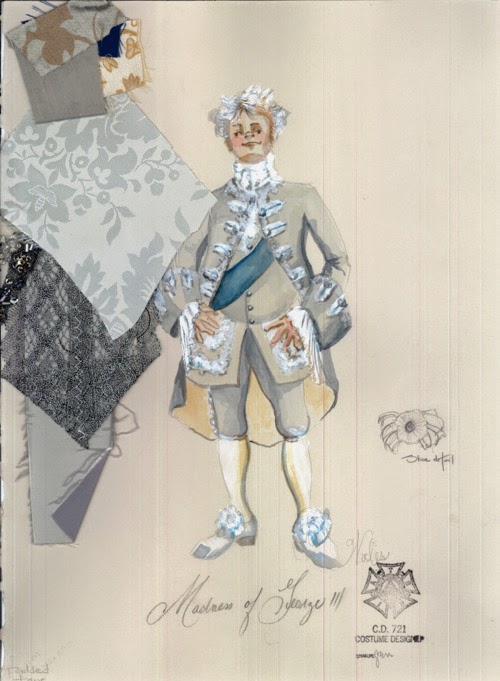
Costume rendering for "The Madness of George III", d.b. Susan Mickey

Set rendering for "Dollywood", d.b. Keith Tucker

Set rendering for "Faust", d.b. Keith Nagy
I wanted to take this traditional method and turn it on its head. At the 2014 USITT Annual Conference, many of the things I learned in my seminars dealt with the capabilities and limits of using digital methods to accomplish the same thing. I had a few examples of physical renderings, and I had many more examples of digital renderings and designs. The originality came through the research and designs I did, creating a fictitious production of each of the shows in order to design for them as if I were designing a real show.
Image URLS -
http://uttad.tumblr.com/post/12653208893/costume-designer-susan-mickey-wins-joseph-jefferson
http://jcu.edu/russertfaculty/nagyportfolio/set_large_web_pics/faust_set_rendering_cathedr.html
http://costumerenderings.tumblr.com/post/22381882097/collectingmarilyn-william-travillas
http://www.keithtuckerart.com/Set_Design.html
Research URLS
http://www3.northern.edu/wild/ScDes/sdhist.htm
http://www.siue.edu/COSTUMES/history.html
http://www.usitt.org/
http://www.lisabohn.com/Design/Costume_Design.html
http://www.vectorworks.net/spotlight/
https://techboard.vectorworks.net/ubbthreads.php?ubb=showflat&Number=165503
Body of Work: Research Question 1 - Cliche
- Avoiding cliches within my body of work
- Because of the nature of my project, there were few "conceptual ideas" that had the potential of being cliche. My designs themselves were an amalgamation of many different influences: The Sherlock Holmes design was based on period-specific clothing, the Titus Andronicus set design and costume design both worked around the design influences of haute couture and modern, aggressive, corporate architecture. Because so much of my work represented specific time periods or clothing styles, there was no real "cliche" to deal with. As for the Traveler design and the Ringleader design, each piece of these outfits was symbolic, and each outfit was influenced by a single piece of art. What I initially started with (combining world travel and the world of theatre backstage) I quickly realized was too big to accomplish before artNow. It turned into an exploration of digital theatrical design, a concept so new in some areas (Costume Design) and so standard practice (scenic and lighting design) that there were almost no other examples of it to be found, at least in terms of its artistic quality as opposed to its use as a tool in the creative process of putting on a show.
- Traveler

"The Temptation of St. Anthony" - Salvador Dali, 1946

- Ringleader

"At the Moulin Rouge" - Henri de Toulouse-Lautrec, 1892-95

Image URLS
http://www.edali.org/temptation-of-saint-anthony.jsp
http://www.artyfactory.com/art_appreciation/art_movements/impressionism.htm
Research URLS
http://www.academia.edu/545804/By_way_of_theatre_Design_Anthropology_and_the_exploration_of_human_possibilities
http://julianabeecher.com/
http://etd.fcla.edu/CF/CFE0003383/Fuss_Alicia_L_201008_MFA.pdf
Subscribe to:
Posts (Atom)